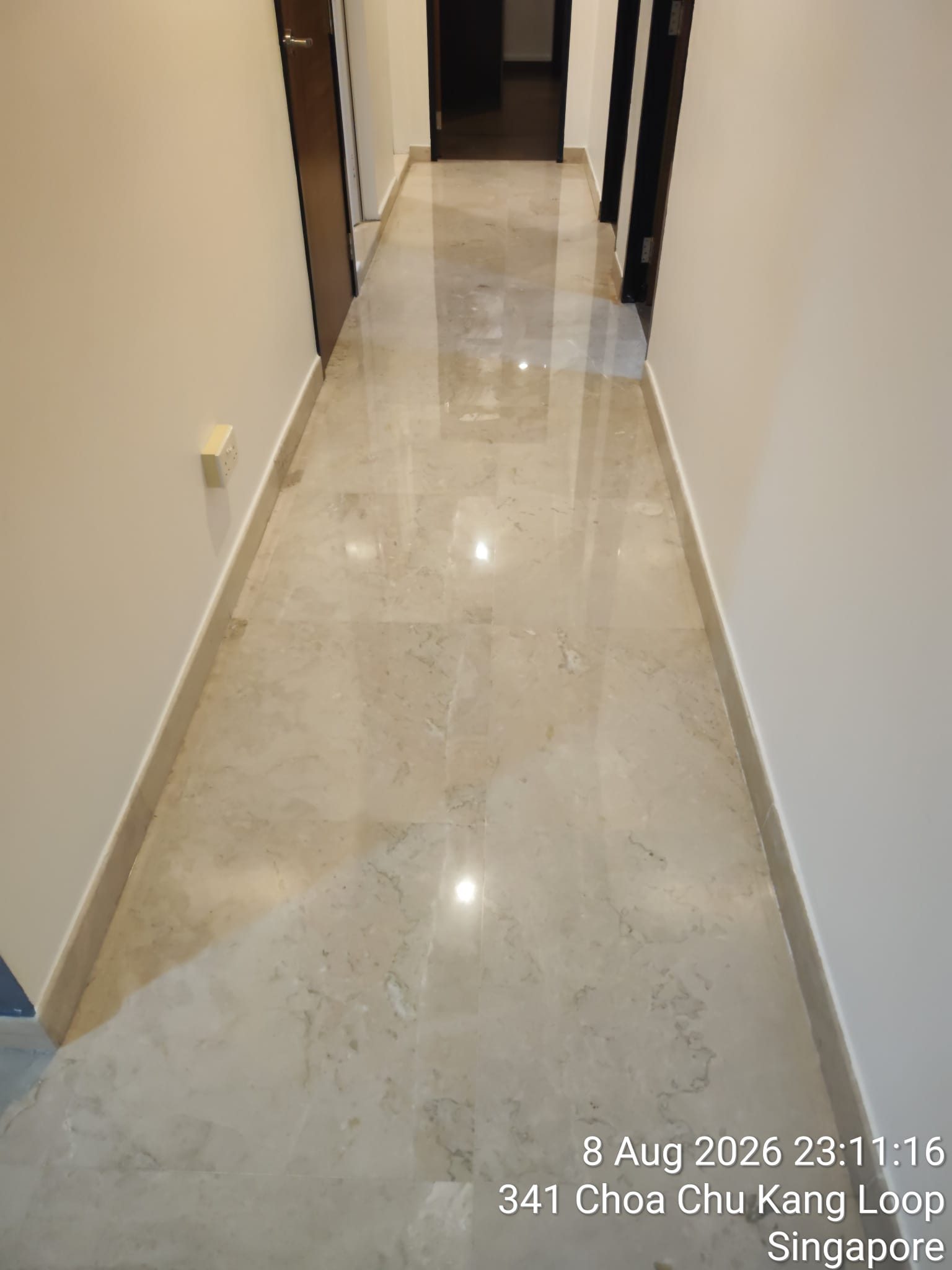
A freshly polished and sealed marble floor — Choa Chu Kang Loop
Sealing gets mentioned as the last step in almost every marble restoration, but what it actually does — and just as importantly, what it doesn't do — is one of the most misunderstood parts of marble care.
What a sealer actually does
A penetrating (impregnating) sealer soaks into the microscopic pores of the stone and lines them from the inside, so that water, oil and other liquids bead up on the surface for longer instead of soaking straight in. It reduces how quickly staining liquids get absorbed — it doesn't sit on top of the stone as a visible coating, and it doesn't change the shine level, which is a separate result of the polishing/crystallization step.
What sealing does not do
This is the part that surprises most homeowners: sealing does not stop etching, and it does not stop scratching. Etching is a chemical reaction between an acid and the calcium carbonate in the polished surface itself — it happens at the surface, not by soaking in, so a sealer underneath doesn't block it. Scratching is physical abrasion of that same surface. A sealer only slows staining and moisture absorption; it's not a general-purpose shield against every kind of damage covered elsewhere in our guides.
Penetrating sealers vs. old-style topical coatings
Modern penetrating sealers are invisible, breathable (they let trapped moisture vapour escape rather than blistering) and don't change the look of the stone. Older-style topical coatings — wax or acrylic finishes sitting on top of the stone — can look glossy at first but degrade under UV light, trap grime as they break down, and are a common cause of the yellowing we cover in our yellow stains guide. If your marble was sealed decades ago, there's a reasonable chance it has one of these older coatings rather than a modern penetrating sealer.
The water-drop test: checking your own floor
You don't need a professional visit to get a rough read on your seal. Drip a small amount of water onto a clean patch of marble and watch it for a few minutes:
- Beads up and sits on the surface — the seal is still doing its job.
- Darkens the stone or soaks in within a few minutes — the sealer has worn through and it's time to reseal.
Test a few different spots, especially high-traffic areas and anywhere water regularly sits, since sealer wears unevenly across a floor.
How often to reseal in Singapore's climate
There's no fixed expiry date — it depends on foot traffic, cleaning habits and how much moisture the floor sees — but as a general guide for Singapore's humidity: roughly every 1–2 years for a normal residential living/dining floor, and closer to annually for bathrooms, kitchens, balconies, or other spots where water sits more often. Commercial floors with heavy foot traffic typically need it more frequently too.
Do you need a full re-polish, or just resealing?
If the shine itself still looks good and the only issue is the water-drop test failing, a standalone resealing visit is enough — no grinding or polishing required. If the floor is also dull, etched, stained or scratched, sealing alone won't fix any of that; it needs the full grind-hone-polish sequence first, with sealing as the final step. See our pricing page for both options.